Straight answers to the questions buyers ask us most. Can’t find yours? Ask us — you’ll get a reply from the people who build the system.
Basics · Hardware & batteries · Software & integration · Buying & support
Basics
What are electronic shelf labels (ESL)?
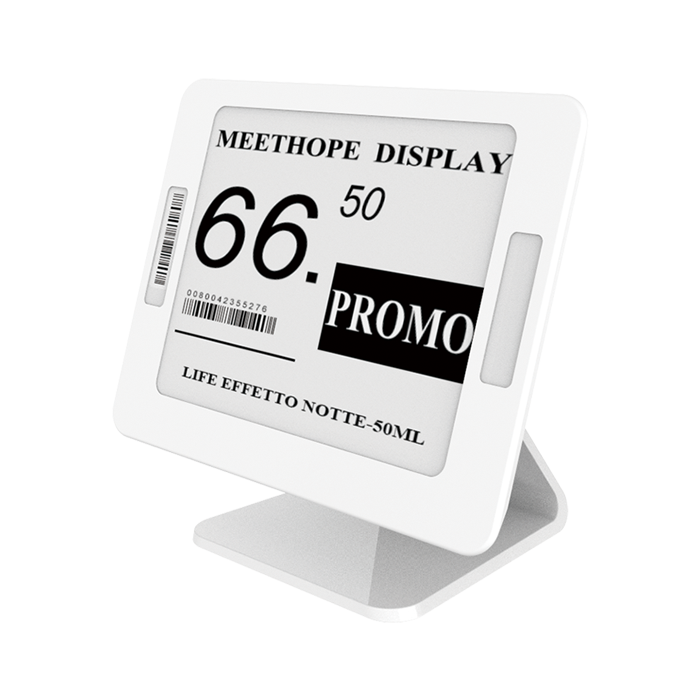
Electronic shelf labels are battery-powered E Ink price tags that sit on the shelf edge and are updated wirelessly. Your POS or ERP sends prices to the ESL management system, which delivers them through a base station to every label in the store.
Which businesses use electronic shelf labels?
Supermarkets and grocery stores, convenience stores, pharmacies, electronics and DIY stores, apparel shops, fresh-produce and cold-chain areas, and warehouses that use labels for picking and location information.
How do electronic shelf labels reduce operating costs?
Staff no longer print and replace paper tags, a price change reaches the whole store in minutes instead of hours, and shelf prices always match the checkout, which removes pricing errors.
Are electronic shelf labels environmentally friendly?
Yes. They remove paper tag printing, and the e-paper screen uses power only when the image changes, so one set of coin-cell batteries lasts for years.
Can the labels show promotions, QR codes and other languages?
Yes. Label templates can combine text, images, barcodes and QR codes, and fonts for your languages are loaded into the system, so the same label can show a regular price, a promotion or a product link.
Hardware & batteries
Which sizes and colours are available?
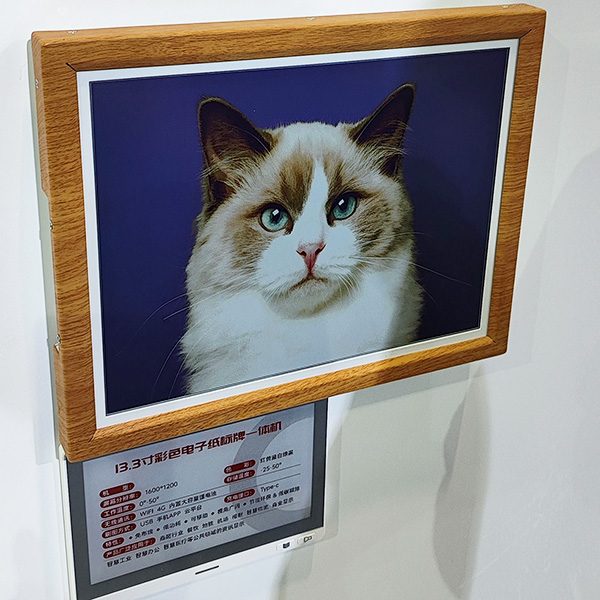
From 1.54" to 13.3" across five series, with black/white, black/white/red and black/white/red/yellow displays. See electronic shelf labels for the full range.
How are the labels powered, and how long do the batteries last?
Standard models run on replaceable CR2450 coin cells. Battery life is typically 5–10 years at 2–4 updates per day; more frequent updates shorten it.
What maintenance do electronic shelf labels need?
Very little. Every label reports its battery level and signal strength to the management system, so you replace batteries only when a label is flagged. Label firmware is updated over the air through the base station.
Do you have labels for freezers and wet areas?
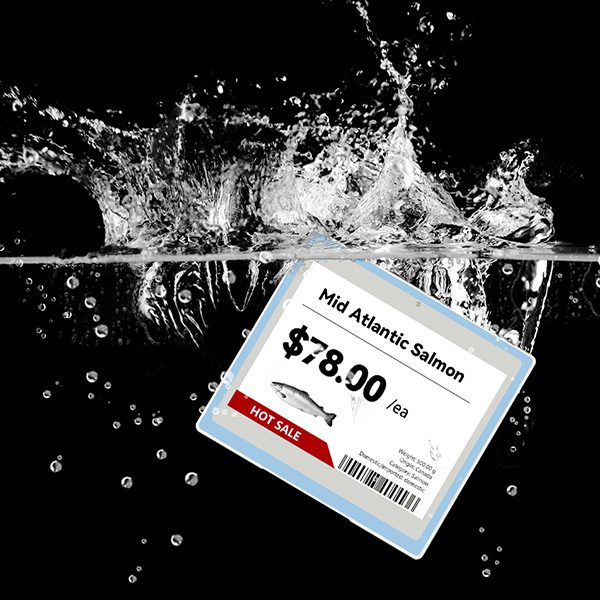
Yes. The freezer models (2.13" and 2.66") are rated from −25 to +30 °C, and the 4.2" waterproof model has an IP67 housing for seafood counters and produce misting areas. Standard labels work from 0 to 40 °C.
Are your labels certified for Europe?
Yes. Our labels and the AES-AP01 base station hold CE-RED certificates (Radio Equipment Directive 2014/53/EU) issued to Guangzhou PanPanTech Co., Ltd. See our certificates.
Software & integration
How do prices reach the labels?
Your POS or ERP sends product data to the ESL management system, the system sends each update to the base station covering that label, and the base station transmits it on 2.4 GHz using a proprietary protocol over BLE 5.2. The labels do not use your store Wi-Fi.
Can the system connect to my POS or ERP?
Yes. Your POS or ERP pushes product and price data through our REST API. Integrators who want to control base stations directly from their own platform can license the MQTT protocol, and SDKs are available for Python, Java and Go.
What software do I need?
Our ESL management system (PPT-SW01). It runs on your own server or private cloud, is used in a web browser and is sold as a one-time perpetual licence without a subscription.
How secure is the system?
Labels and base stations communicate over an encrypted proprietary protocol with store-level key management. With an on-premise installation, all product and price data stays on your own server.
How many base stations does a store need?
One AES-AP01 base station typically covers a radius of 20–25 m indoors, depending on shelving and walls. Send us your floor plan and we will suggest the number and positions.
Buying & support
What is the minimum order and lead time?
Swift in-stock models start at 100 pieces per model and ship in 3–7 days; Classic starts at 500 pieces (15–25 days); the OEM series Lite, Slim and Rock start at 2,000 pieces (25–35 days). Different models can be mixed in one order.
Can the labels carry our own brand?
Yes. With the Lite series, the housing colour, printed logo, retail packaging and the software interface can all carry your brand.
Do you have your own factory?
We design the Lite, Slim and Rock hardware, the firmware and the management software, and our manufacturing company places the production orders. Production runs at three long-term partner factories — Guangzhou for samples and small batches, Foshan for volume production, Shenzhen for the Classic series and base stations — with inspection done jointly. You are welcome to visit with us; see how our labels are made.
What warranty do you offer?
12 months on labels, base stations and other hardware from the date of shipment, covering manufacturing defects and failures in normal use. See service and support for how to claim.
What support do you provide?
We help with planning and installation remotely, and on-site deployment can be arranged on request. After installation, the same team that sold the system supports it by email, WhatsApp and phone; hardware issues are handled under warranty and software issues by our own software lead.
How long does a rollout take?
A pilot with a demo kit can start within days. For a full store, timing depends on the number of labels, your integration and the installation team; we plan it with you before you order.
How do I estimate the return on investment?
The savings come from labour for price changes, paper tag printing and pricing errors at checkout. Our sister site AiESL covers ESL return on investment in detail; send us your store numbers and we will work through them with you.