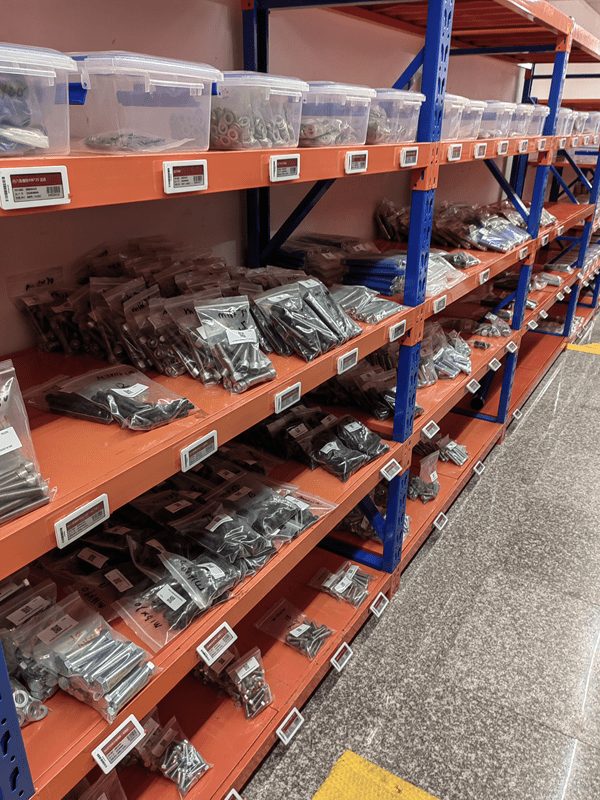
In warehouses, spare-parts stores and industrial distributors, electronic shelf labels replace paper bin cards and printed location tags. Each label shows what is stored in a location — part number, description, quantity, barcode or QR code — and updates from your WMS or ERP when stock moves, so staff stop reprinting and re-sticking labels after every change. This guide covers bin and location labelling, trade-counter pricing, cold storage and rollout planning, with examples from projects in China and Chile.
Why replace paper bin cards and location tags
Paper labels in a warehouse fail in predictable ways. A part is moved to a new location but the old tag stays; quantities written on bin cards fall behind the system; tags fade, tear or fall off racking; and every re-slotting project ends with hours of printing and sticking. The result is time lost searching, wrong parts picked, and stock counts that do not match the system.
Electronic labels connect each physical location to the data in your WMS or ERP. When the system changes — a new part is assigned to a bin, a quantity is updated, a location is blocked — the label on the rack changes too. Because the labels run on batteries and talk to ceiling-mounted base stations by radio, they can be fitted to existing racking without cabling.
- One source of truth — the label shows what the system says is in the location.
- Faster re-slotting — labels are rebound in the system instead of reprinted.
- Fewer picking errors — part number, description and a scannable code at every position.
- Durable — no fading or peeling; reinforced housings are available for busy aisles.
- Visible status — labels can show notes such as “reserved”, “quarantine” or “reorder”.
How labels fit warehouse workflows
| Workflow | What the label does |
|---|
| Receiving and put-away | Shows the part assigned to each location so goods go to the right bin; the label updates when the location is assigned. |
| Picking | Shows part number, description and a barcode or QR code to scan for confirmation. |
| Cycle counting | Shows the system quantity and last count date so counters can spot differences. |
| Re-slotting | The label is rebound to the new part in the system; no new label is printed. |
| Blocked or quarantined stock | A status line or colour highlight on four-colour labels marks locations that must not be picked. |
Labels with an indicator LED (available on the Classic series) can also flash on command to help locate a bin; ask us how this fits your WMS and integration.
About the examples below: these projects were delivered in 2023 by our founder Panda Wang and members of our team, before the AiEInkSmart brand launched in 2024. Customer names are withheld.
Spare-parts and MRO stores
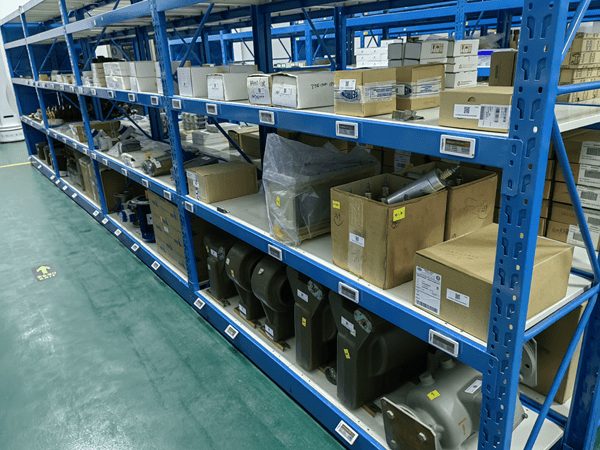
Example: spare-parts warehouse at a hydropower plant, Zhejiang, China
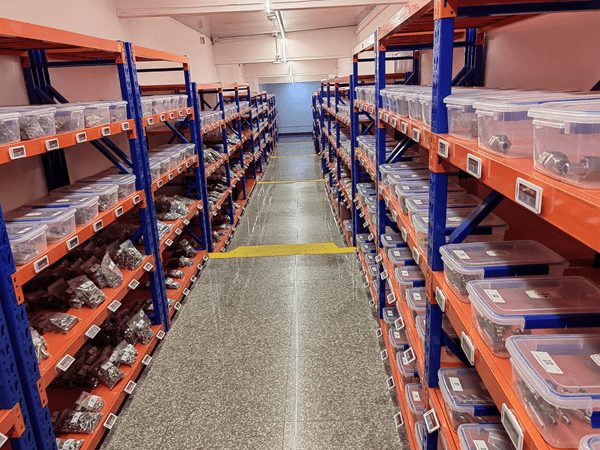
A hydropower plant stores its maintenance spare parts — small parts in bins and boxed equipment — on steel racking. Electronic shelf labels are mounted on the front beams of the shelves, one per storage position, so each position shows the part it holds. When a part is moved or a record changes, the label is updated from the system instead of being rewritten or reprinted by hand.
For maintenance stores like this, the value is in finding the right part quickly during a repair. A clearly labelled location with the part number and description, and a code that can be scanned, reduces the time a technician spends searching and the risk of taking a similar-looking part.
Spare-parts racking with one label per storage position.
Industrial distributors and trade counters
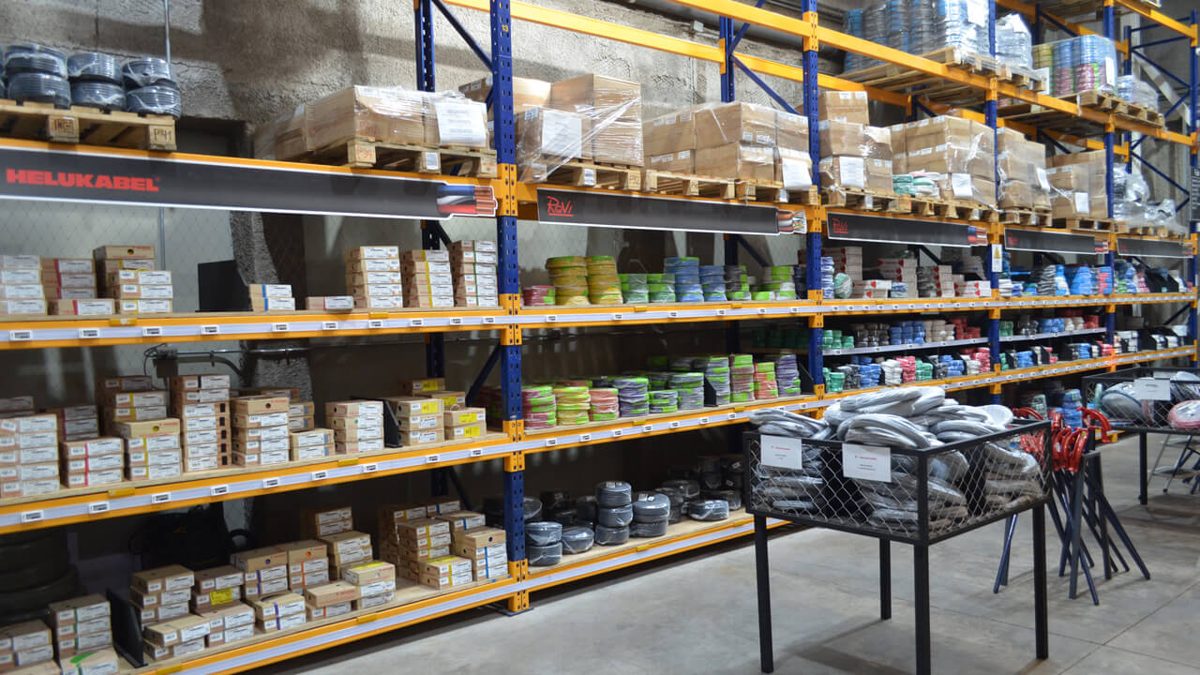
Example: electrical-supplies distributor, Chile
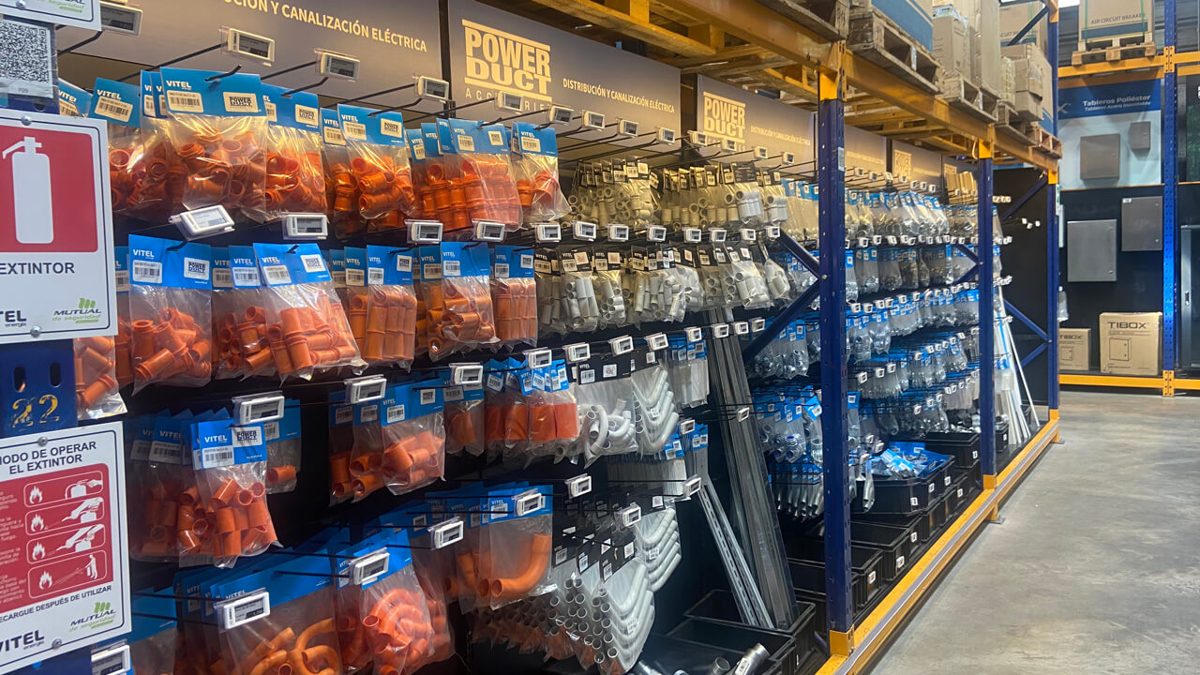
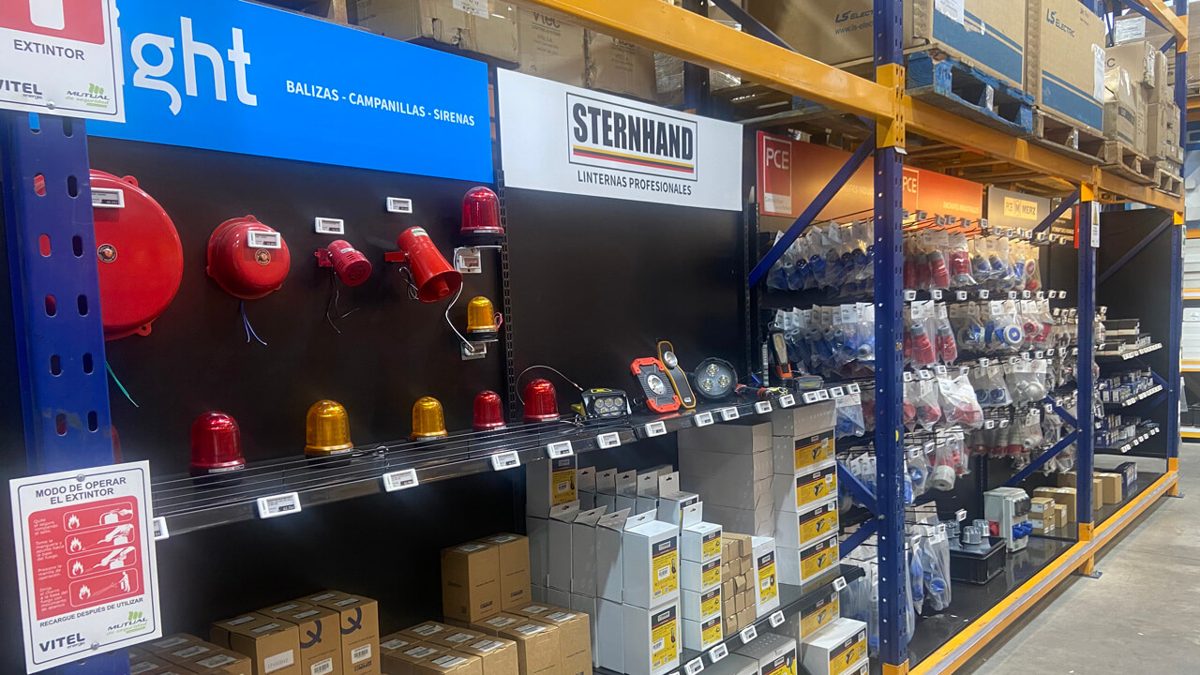
An electrical-supplies distributor in Chile sells from a warehouse-style store: cables, switchgear, protection devices and installation material sit on pallet racking and hook displays. Electronic shelf labels on the rack beams and hooks show each product’s name, code and price, so price changes reach the shelf without relabelling every position by hand.
Trade customers buy by product code, so the code is printed prominently next to the price. Distributors with frequent supplier price changes — common for cable and metal-based products — benefit most, because the shelf follows the price list automatically.
Warehouse-style trade store with labels on racking and hooks.
Cold storage and harsh areas
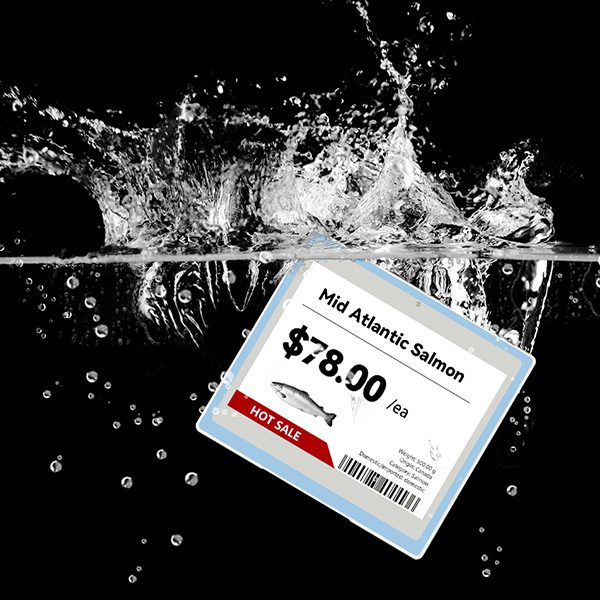
Freezer labels are rated from −25 to +30 °C for chilled and frozen locations, and the 4.2" waterproof label has an IP67 housing for wash-down areas. For busy aisles where labels may be knocked by trolleys or boxes, the Rock series uses a reinforced 12.9 mm housing and higher-capacity batteries. Remember that cold rooms, freezer doors and insulated walls block radio; place a base station with a clear path into cold areas.
Hardware for a warehouse deployment
| Part | Recommendation |
|---|
| Bin and shelf-beam labels | 2.13"–2.9" (electronic shelf labels); Rock series for a reinforced housing |
| Rack-end and location labels | 4.2" – 7.5" |
| Aisle and zone signs | 10.2" – 13.3" large-format labels, no cabling |
| Cold storage | Freezer models, −25 to +30 °C |
| Mounting | Rails for shelf beams, clips for flat surfaces and hooks, hangers for overhead signs |
| Base stations | AES-AP01, typically 20–25 m radius indoors; high metal racking shortens range, so plan overlap per aisle |
| Software | ESL management system on your own server |
Integration with WMS and ERP
Your WMS or ERP sends location and item data — location code, part number, description, quantity, barcode and up to 32 custom fields — to the management system through our REST API. The system renders each label from its template and delivers updates through the base stations; labels report their battery level and signal strength back. Integrators who want to control base stations directly from their own platform can license the MQTT protocol, and SDKs are available for Python, Java and Go.
Template ideas for warehouse labels
- Bin label: location code, part number in large type, short description, quantity and a QR code.
- Trade-counter label: product code, description, unit of sale and price.
- Status label: location code with a red “blocked” or “quarantine” banner on four-colour labels.
- Aisle sign: aisle number and the range of locations or product groups it holds.
Planning a warehouse rollout
- Count locations by type: bins, shelf beams, rack ends, cold areas.
- Check the racking profile and choose rails, clips or hangers to match.
- Survey radio coverage with a base station in a typical aisle; metal and stacked goods affect range.
- Pilot one aisle with an ESL demo kit and a trial connection to your WMS.
- Install by zone, binding each label to its location by scanning.
- Train the team on rebinding labels during re-slotting and replacing batteries when flagged.
What drives the cost
The budget depends on the number of locations and label sizes, base stations for the floor area and racking height, mounting accessories, cold-storage or reinforced models where needed, the software licence and the WMS or ERP integration. We quote per project after a location count and a look at your racking and layout.
Electronic labels compared with printed barcodes and RFID
Warehouses already use printed barcode labels and, in some cases, RFID. Electronic shelf labels do not replace either; they solve a different problem. A printed barcode label is cheap and reliable for identifying a fixed location, but its human-readable text cannot change — every time the location’s content changes, the label has to be reprinted. RFID identifies items or containers automatically, but tells the person standing at the rack nothing. An electronic label sits between the two: it carries a scannable barcode or QR code like a printed label, and it shows changing information — the current part, quantity or status — to the person in the aisle.
| Printed barcode label | RFID tag | Electronic shelf label |
|---|
| Human-readable content | Fixed | None | Updated from the system |
| Scannable | Yes | By reader | Yes (barcode or QR on screen) |
| Re-slotting effort | Reprint and replace | Re-encode or replace | Rebind in software |
| Power | None | None (passive) | Coin-cell battery, years of life |
Many sites combine them: fixed barcode labels for permanent infrastructure such as aisle and bay numbers, and electronic labels on the bins and shelves whose contents change.
Line-side storage and kanban in production
The same approach works on the factory floor. Line-side racks and supermarkets that feed assembly lines hold parts whose assignment changes with each product variant or model change. Electronic labels on these racks show the part number, the line or station it feeds and the kanban quantity, and they update when engineering changes the bill of materials or production switches to another variant. Because there is no cabling, racks can be moved when the line layout changes, and the labels move with them.
- Kanban cards: part, supplier, kanban quantity and a QR code, shown on the bin instead of a laminated card.
- Model changeover: labels on line-side racks switch to the next variant’s parts in one update.
- Tool and fixture storage: location labels for jigs, fixtures and tools, with calibration due dates.
Inventory accuracy and audits
Inventory accuracy depends on the physical location and the system record agreeing. Electronic labels help by making the system record visible at the rack: during a cycle count the counter sees the expected part and quantity on the label and can confirm or flag a difference immediately. For audits, the location data shown on each label comes from the same database the auditor checks, which removes the question of whether a handwritten bin card is up to date. The management system’s operation logs also record when labels were bound or updated.
Practical tips from installations
- Label the beam, not the box. Mount labels on the shelf beam or bin front so they stay put when boxes are replaced.
- Keep the part number large. Pickers read from a distance and at an angle; the description can be smaller.
- Plan for height. For high racking, use larger labels at upper levels or a location sign at the rack end listing the levels.
- Check coverage under load. A full warehouse blocks more radio than an empty one; test with stock on the shelves.
- Assign ownership. Decide who rebinds labels during re-slotting and who replaces batteries when the system flags a label.
FAQ
Can electronic shelf labels replace bin cards in a warehouse?
Yes. Each label shows the part number, description and quantity for its location, plus a barcode or QR code for scanning, and updates when your system changes the data.
Do the labels work on metal racking?
Yes. They mount on standard rails and clips on steel shelving. Metal does reduce radio range, so we plan base-station positions so that every aisle is covered, usually with overlap.
Can the labels connect to our WMS or ERP?
Yes. Your WMS or ERP sends data through our REST API; integrators who want to drive the base stations directly can license the MQTT protocol.
Do you have labels for freezers and cold rooms?
Yes. Freezer models are rated from −25 to +30 °C. Place a base station with a clear radio path into cold rooms, because insulated walls block signals.
How durable are the labels in a busy warehouse?
Standard labels have an ABS + PC housing; the Rock series adds a reinforced 12.9 mm housing and higher-capacity batteries for demanding areas.
Planning a warehouse or spare-parts store? Send us a rack layout and the number of locations and we will propose label sizes, mounting and base-station positions — or start with an
ESL demo kit.